
This article by R.B. was published at Palladium Magazine on November 2, 2026.
Become a PALLADIUM member today! You will receive our beautiful quarterly print edition and help support our non-profit publication.
After a friend’s wife died too young from an aggressive form of cancer, leaving a husband and young daughter, my husband and I went out to dinner at our favorite Jewish deli to process our feelings. Sitting in our favorite maroon booth, my husband suddenly said, “I need to talk to you about something.”
He looked serious, like he might be about to propose, but we were already married. “I’ve been looking into cryonics,” he said. “And I want you to seriously consider it.”
I pondered a diner-appropriate response, noticing the deli case across the counter, where rows of smoked and pickled fish stared up at me with their cold, glistening eyes. “I don’t think cryonics is technically kosher,” I finally said. “Besides, if I’m frozen at the end of my life, I’ll still be old when I wake up anyway. What if we agree to clone each other instead? That’s a much more established technology. We could even make lots of clones, with instructions to follow up with them over the years to see how their personalities and life trajectories compare to ours.”
My husband emphatically shook his head. “They won’t have our memories, our love story. I don’t care how old you are when you wake up, one lifetime with you just isn’t enough,” he said, grabbing my hands across the table. “Promise me you’ll seriously think about it?”
I found myself seriously thinking about it a year later, in the basement of an Oakland hospital while my husband lay in the morgue, dead from a random heart attack in his late thirties.
“I know this was unexpected,” the funeral director told me. “But do you have any ideas about what his final wishes might be?”
Cryonics was not an option. We did not subscribe in time to one of the companies that whisks one’s body away at the moment of death for freezing; besides, cryonics had not yet solved that thorny problem of how to freeze human tissue without causing the water inside it to crystallize and destroy the cellular structure.
So our options were burial or cremation. Putting aside the specific impossibilities of cryonics, neither of these choices fulfilled even the spirit of my husband’s final wishes. He wanted to be kept with me. Not metaphorically, but physically and literally. Both options seemed jarring. One moment, he and I were considered “one flesh,” and the next his body was being treated like garbage, to be burned or buried—as a hazard to be disposed of as quickly as possible.
“Is there a third option?” I asked. “To keep him with me, but without cremation?”
“I’m not sure I understand,” the funeral director replied.
“Well, you know…” I said.
Such is the fundamental hypocrisy underlying modern burial: in all areas of public life, we must act as if there is no eternal soul, because we are enlightened people of Science. We must believe only in what can be observed and measured: genes, germs, and currency. Then, suddenly, when all that is left of a loved one is their physical body, social convention and legal mandates require us to immediately flip our worldview upside down and accept platitudes like “he’s not in there anymore” and “he’s moved on.” The physical form of our loved ones is reduced from the essential truth of who they are to a disposable container, an empty soda can.
In other words, everyone claims to be an enlightened, modern materialist until you tell a funeral director you’d like to keep one of your husband’s bones. He said he would do some research and call me back.
My husband and I pledged a lifelong commitment to each other, lived together, and planned to have children together, but once he died his body was immediately in the custody of the morgue, then the coroner’s office, and then the funeral home. We had woken up that morning as one entity before G-d; a few unlucky hours later an army of strangers and regulations stood in between us. I hadn’t realized when I called 911 and let the paramedics take my husband away to the hospital that I was relinquishing my right to him forever.
Of course, human remains must be monitored by some public entity, for public health and forensic reasons. But I was blindsided by how few rights people and their families have to decide the ultimate fates of their bodies. While it might seem there are many ways to handle a non-sentient human body, the funeral director ultimately informed me there are only two: disposal or donation.
If you express the desire to keep some part of your loved one with you, as I did, you might be encouraged to choose cremation, as I was. What I did not know is that the ashes one receives from cremation are completely biologically indistinguishable: after being heated to between 1,400 and 1,800 degrees Fahrenheit and then pulverized, all DNA and anything else that made your loved one unique has been destroyed.
Cremated remains are so inert and uniform that the only way to tell them apart is through a documented chain of custody process—that is, the paperwork. Scientists have successfully sequenced DNA dating back to around 2 million years ago, meaning you have a better chance of identifying different Pliocene-era organisms or solving the 5,000-year-old murder of Ötzi the Iceman than you would ever have of locating your loved one’s ashes in the case of an administrative error.
If you prefer not to permanently destroy every unique quality of your loved one’s body, you might choose burial. But even in this case, your options are limited. To honor my husband’s wishes to keep us as physically close as possible, I inquired about a shared coffin. Surely that wasn’t too much to ask, for two people who pledged their eternal futures together? Apparently it was. As the funeral director informed me, the logistics required to exhume a grave make burying two people together in the same coffin essentially impossible unless they die at the same time.
The cost of mitigating health and safety risks are of course extensive. To avoid sickening bystanders with the caustic liquid and gaseous byproducts of human decomposition, exhumation requires full PPE, negative pressure tents, and disinfecting solutions. Then the process requires thousands of dollars of fees: several thousand dollars to the funeral home (exhumation requires the oversight of a licensed funeral director), plus the cemetery’s opening and closing fees, monument resetting and property restoration fees, a vault disruption fee, and a casket replacement fee. Then there are the legal and permitting costs, to lawyers and public agencies, of which there are many. Even if you are able to cover every necessary expense, it still wouldn’t matter: exhumation is legally forbidden except for the purposes of relocation or forensic examination.
Dissatisfied with cremation and still determined to fulfill my husband’s final wishes of keeping us together, I inquired about being buried in adjacent coffins, side by side, so I could at least take comfort in the fact that time would soon disintegrate the thin wooden wall dividing us. Such desire was the basis for one of the most infamous scenes in Western literature: in the gothic novel Wuthering Heights, romantic antihero Heathcliff bribes a gravedigger to excavate the ground next to his beloved Catherine and remove the side of her coffin so his body can eventually rot together with hers.
Such romantic gestures are not feasible these days: most cemeteries require each casket to be buried in a separate vault made of reinforced concrete plastic, metal, or fiberglass. In rare cases, a select few cemeteries might allow two caskets to be stacked on top of each other in the same vault, but this option is rare. In the vast majority of cases, burial forfeits any future possibility of physical presence with your loved one.
Donation is another option besides burial and incineration, in which case there is no semblance of maintaining the right to personal or familial autonomy over one’s body. A donated body may be resold, dismembered for pieces, or left to rot. The cruel irony is that for the price of just a few thousand dollars per body, body brokers and research institutions are granted vastly greater options and control over a body than its owner or next of kin can legally attain for any price.
These regulations represent a marked departure from the ancient and widespread human desire to preserve their physical form after death. Mummification—the deliberate preservation of bodies to prevent decay for as long as possible—is almost inextricable from the human experience. Mummification practices have been documented on every continent where humans have lived, from the smoke-dyed human remains of hunter-gatherers in Asia dating back to 10,000 BC, to the temperature-controlled casket containing the embalmed remains of young Rosalia Lombardo, the “Sleeping Beauty” who rests in the Capuchin catacombs of Palermo in Sicily, preserved in 1920. Many cultures have also practiced forms of excarnation, or removing the flesh from a body to preserve their bones in an ossuary.

The reframing of human bodies as hazardous waste has ironically coincided with enormous advances in the types of science that would make human biological preservation safer and more affordable than ever before. The chemicals that nearly perfectly mummified Rosalia Lombardo for a century cost barely $100 today. Small taxidermy projects, including excarnation of a medium mammalian skeleton, can be completed for several hundred to several thousand dollars, less than the cost of a moderately nice coffin. Biohazard risks can be mitigated better than ever before. Most of these prices are theoretical, however. In practice, the legal barriers, regulatory burdens, and correspondingly tight market of qualified professionals can balloon the costs of preserving even non-human remains. And applying such skillsets to human remains is never permitted, as the funeral director tactfully informed me.
“Abuse of a corpse” laws are oft-cited as the reason behind the extreme restrictions and administrative burden around burial practices. Classy, cultured people are supposed to recoil with horror at those old stories of real human bodies being used in scare mazes and carnivals. We are supposed to be relieved that our merciful administrative state stepped in and mandated that these bodies instead rot anonymously in the dirt to rot or burned into cinders. All right-minded people, we are told, should want some version of this for their body, regardless of their varying personalities or unique perspectives. In life, people may be adventurous, inquisitive, humorous, quirky, irreverent, avant-garde, creative—yet the state would have us believe that no one would want their body made into art, used in theatre productions, displayed in a science classroom, or—worst of all—to become part of something fun like a ride at their favorite amusement park.
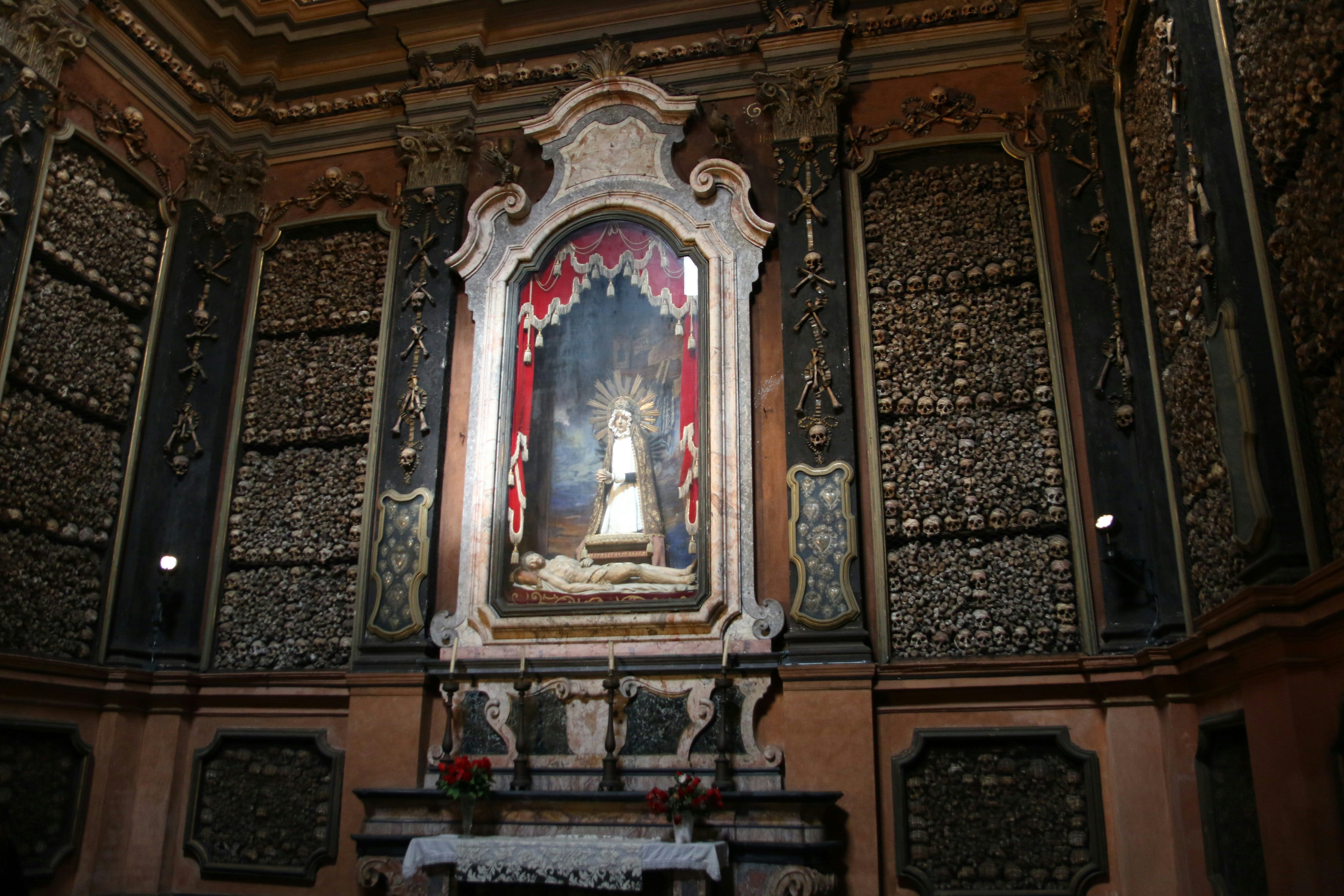
In response to these assumptions, I feel compelled to demonstrate that the line between exploiting and honoring the dead has always been blurry. The Sedlec Ossuary, or “Bone Church,” in Kutna Hora, Czech Republic contains bones from at least 40,000 skeletons. Most are stacked in large pyramids behind locked metal gates, but the church’s early designers shaped and bound some together into decorative columns, a chandelier, a coat of arms, and most infamously, their own initials as a way to sign off on their work. Scientists and historians have added their own contributions: interspersed among the Baroque decor are modern exhibits displaying bones of particular academic interest, such as those showing evidence of genetic disorders, old medical procedures, or injuries from major historical battles.
When I visited, local guides solemnly reminded visitors to treat this first and foremost as a religious monument, not a tourist attraction. Meanwhile, the official Czech Tourism Authority describes the ossuary in lurid terms, daring travelers to witness its “chilling” and “bizarre” sights. Local guides are thus entrusted with the unenviable task of instructing visitors on the clear moral difference between turning the bones of plague victims into a giant chandelier or medical curiosity (respectful) and using them to write one’s initials on the wall (disgraceful). Lost in these efforts to clearly delineate ritual from exploitation is the basic truth that all successful religious and scientific monuments must inherently contain an element of spectacle, for spectacle is the long-used vessel of the sacred.
Before the death of my husband, I was a philosophical sentientist, believing that consciousness to be the basis of morality; thus, I believed the meaning of life to be preventing sentient beings from suffering. Managing the burial process after an early, unexpected death caused me to rethink my bias toward sentience as the ultimate unit of moral measurement. Sentience and consciousness matter, but they are only a small part of the totality of human existence. Michelangelo’s neck pain while painting the Sistine Chapel probably seemed to be the most prominent aspect of his existence on some days, as anyone with chronic back pain can attest. But most people would agree that measuring the meaning of Michelangelo’s life merely in units of how much he suffered during his 88 years of sentience would largely miss the point.
Ultimately, I have moved toward a more maximalist view of the meaning of a human life. Until death itself is cured, sentience will continue to be a comparatively brief phase: consciousness lasts mere years, while the material effects of our decisions, our works, and our physical form can endure for centuries.
After his death, every aspect of my husband’s existence outside of his consciousness increased in importance to me: his work, ideas, friendships, possessions, and indeed, his body. I became obsessed with any object that had physically touched him most recently; I could not bring myself to throw away the medical waste the EMTs left in our apartment after his heart attack. Eventually, friends and family had to perform this task for me. At night, I wanted to return to the ER waiting room where I had last sat waiting for him. If I couldn’t go back in time or bring back his consciousness, I wanted to at least occupy the same physical space where he had last been. When a friend admitted she had kept a piece of my husband’s burial suit for me, I nearly cried with gratitude, as if I had been allowed to hold his hand one more time.
People had warned me about the “predatory” funeral industry, that would try to upsell me on funeral items and experiences during my vulnerable time of mourning. If anything, I was surprised how often I was encouraged to choose the cheap, easy, convenient option. Those who cannot afford a wooden casket may now be offered a cardboard one; those who cannot afford the many thousands of dollars for a burial are encouraged to cremate. “Do whatever you want with my body,” I often hear people say. “If I’m dead, I won’t know the difference, don’t spend the money.”
But it’s clearly not only about the money; the wealthy are also being sold the concept of tastefully disappearing. The most expensive venue we toured when planning my husband’s funeral was a “natural” cemetery, which prohibited embalming chemicals and encouraged natural decomposition through the use of biodegradable materials and practices certified by the Green Burial Council. In this natural cemetery, gravemarkers were often too tiny to see or omitted altogether; the overgrown vegetation was chosen to serve the welfare of the local wildlife rather than the accessibility to human visitors. The intense focus on discretely subsuming human remains back into the natural landscape resulted in steep, narrow pathways that were often too slippery or steep for us to traverse.
Of course people should be allowed to tastefully disappear their bodies if they like. And yes, burials can be expensive. What concerns me is the lack of choice we possess over the largest span of our existence—our post-sentient state—during which the rights over our bodies are artificially limited by the confluence of regulatory capture, inflated costs, and unquestioned cultural assumptions.
There has been some progress in granting people rights to the non-sentient parts of themselves. In 2023, Oregon passed legislation allowing medical patients to keep amputated body parts after patients reportedly refused lifesaving surgeries that required permanently destroying or discarding their amputated limbs. But for now, at both ends of the socioeconomic spectrum, we are encouraged to disappear as quickly as possible once our moment of sentience has passed. In many circles, there is an implicit disregard, or even embarrassment, at the idea of being unapologetically physically human—of leaving a lasting, noticeable mark upon the earth.
In school, I was once taught that many anthropologists consider burial practices to be the defining characteristic of culture; the dividing line between human and nature. At the time, I didn’t understand why civilization’s defining characteristic should be so functionally useless—burying the dead did not increase the chance of survival like practices related to obtaining food, shelter, and protection for the living.
Anthropology’s emphasis on gravesites is partially a pragmatic appreciation for their wealth of physical artefacts—fortunately, past cultures were not so confident in the uselessness of their dead. But now I see that funerary rites also represent the three necessary qualities of a civilization: valuing material legacy, honoring the wishes of one’s neighbor even when we know they are not watching, and a belief in a shared future.
It’s through these three fundamentals of civilization that we have pyramids, churches, a corpus of scientific knowledge, and other monumental wonders, most finished long after the original architects were no longer sentient to witness them. Until we achieve eternal consciousness, or finally solve cryonics, perhaps we should more seriously protect our current avenues to immortality.
R.B. is a writer and consultant interested in policy and progress studies.
PALLADIUM is the first magazine of the third millennium. We are non-partisan, non-profit, and on a mission to discover what the future of governance and society will look like.
Become a PALLADIUM member today! You will receive our beautiful quarterly print edition and help support our mission.
We thank Pardon, for underwriting our work in 2026 with their generous gift.