
This article by Marko Jukic was published at Palladium Magazine on August 7, 2026.
Become a PALLADIUM member today! You will receive our beautiful quarterly print edition and help support our non-profit publication.
Just a few weeks ago, on the seventeenth of June, U.S. President Donald Trump signed the fourteen-point Islamabad Memorandum of Understanding (MoU) with the Islamic Republic of Iran, which promised to bring the ongoing war with Iran to an end by establishing a sixty-day ceasefire period, during which maritime traffic through the Strait of Hormuz would go unhindered by either side and deeper negotiations on issues like Iran’s nuclear ambitions would take place. Unfortunately, despite high hopes, Iran began striking civilian ships in the strait just days later.
Continued closure of the strait risks sinking the global economy into a prolonged economic depression. Oil and natural gas make up 58 percent of all global energy consumption—for electricity, transportation, and heating alike. The region around the Persian Gulf produces 31 percent of the world’s crude oil and 18 percent of the world’s natural gas, furthermore accounting for 42 percent of all global oil exports and 27 percent of all global liquefied natural gas (LNG) exports. Oil and gas are also irreplaceable basic chemical inputs in manufacturing and modern agriculture. Before the war, the strait saw roughly 20 percent of the world’s oil and gas supply pass through it every day.
A global economic depression of this scale would wind up defining the Trump administration’s legacy, and in the most negative possible way—plummeting stock markets, skyrocketing prices, rising unemployment, and unpredictable shortages. It would all but guarantee a Democratic Party victory in the 2028 U.S. presidential election. The parallels to President George W. Bush’s second term are easy to draw: interminable Middle Eastern wars of choice and a sudden economic crisis see the Republican president leave office with record-breakingly low approval ratings. His designated successor is trounced in the election by a charismatic Democrat promising economic relief to the common man.
It would be not just Trump personally who is discredited and demoralized, but his political allies too and the entire populist current that he symbolizes, not just in America but internationally. Populist politics are a lost cause if populist leaders accidentally cause as much damage to their constituents’ interests as establishment leaders cause intentionally.
The Strait of Hormuz is nonetheless something of a red herring when it comes to understanding and expeditiously resolving this conflict. The core problem is not maritime administration, but one that receives far less attention in news headlines and incredulous commentary than it deserves: Iran’s extremely efficient, robust, and technologically advanced military-industrial base, which is what has allowed Iran to consistently bomb the entire region, seemingly at will, for the last five months.
Iran Has the Upper Hand in Military Technology
When pundits or journalists do discuss Iran’s military-industrial base, it is framed as “Iran’s missile and drone arsenal”—as if Iran has a set number of drones and missiles that it will eventually run out of, and, after all, since we all know that Iran is a Third World economic basket case, it must have somehow acquired these advanced weapons in an improper way anyhow, and so the ineffable universe will conspire to eventually rid Iran of its advanced weapons programs in a manner we cannot quite predict but are certain must happen.
All of this is dangerously misguided and wishful thinking, downstream of a general bias to think that the U.S. military cannot ever be technologically out-innovated. Precision-guided, long-range bombs capable of evading air defenses—whether in the form of ballistic missiles, fixed-wing drones, or anything else—used to be the kind of technological marvel upon which U.S. global military supremacy rested, easily defeating the rinky-dink armies of tinpot dictatorships relying on goose-stepping infantrymen and Soviet tanks.
Unfortunately, this technological marvel has been commoditized. Due to the same processes that have caused globalization, deindustrialization in the developed world, and economic growth in the developing world, the U.S. is no longer the only country capable of firing missiles over thousands of kilometers with deadly accuracy. Over the decades, industrial expertise has slowly and inevitably diffused past the borders of the U.S.-aligned world, especially to China, making what were previously advanced mechanical and electronic components and materials far more commonplace, affordable, and replicable.
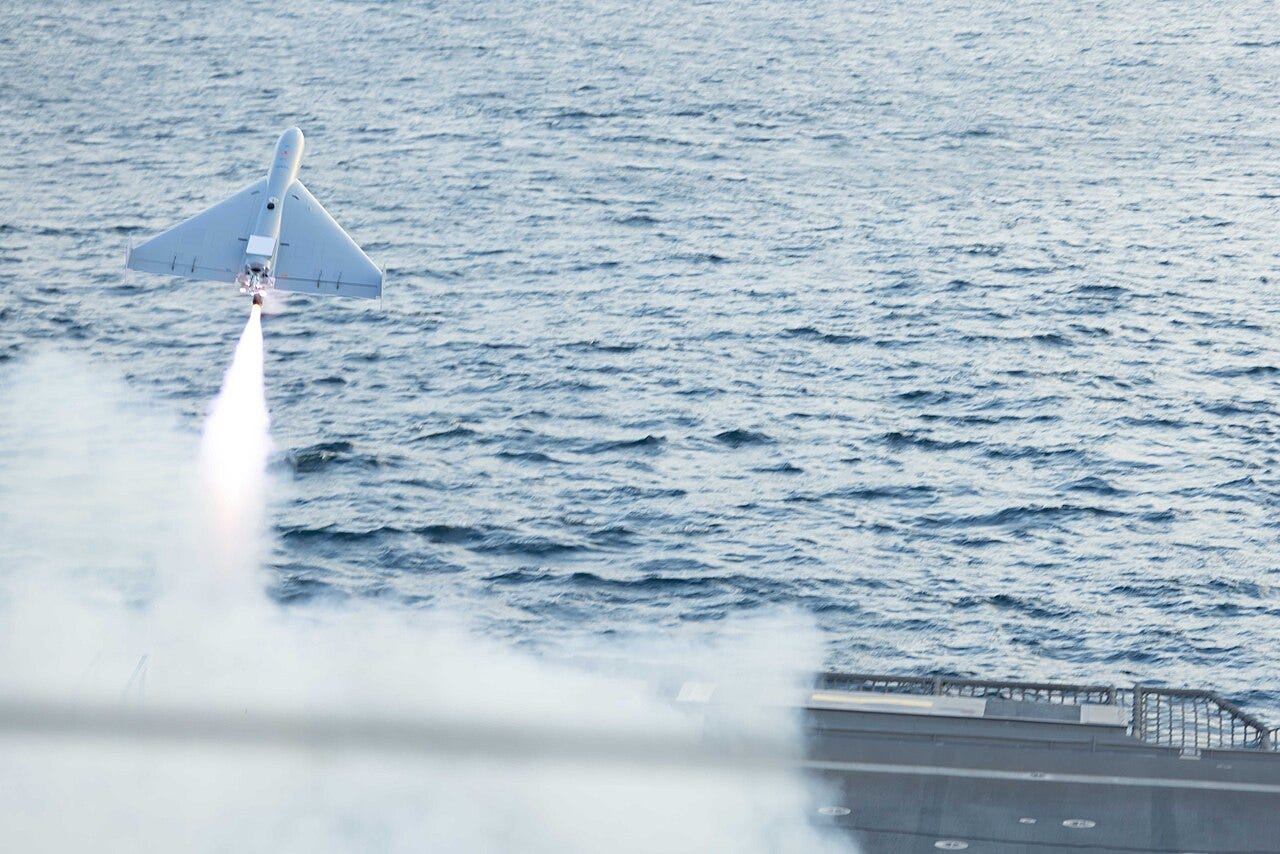
Just as crucially, recognizing its own strategic and military limitations, Iran has aggressively pursued technological progress in drones and missiles for decades, with the ultimate result today that it has altered the fundamental balance of military power between the Iranian armed forces and their U.S.-equipped adversaries. Iran has not improperly acquired advanced technology, in fact it rather deserves the credit for inventing and popularizing the low-cost, fixed-wing, one-way attack drone through its Shahed-131 and Shahed-136 models, which have since been directly imitated not just by the Russian and Chinese militaries, but the U.S. military too. It is a rare thing for a heavily-sanctioned developing country to innovate a military technology that is then quickly validated through imitation by all of the world’s military superpowers.
By the same token, many people would likely be surprised to find out that Iran has a functional space program that first successfully launched an Iranian-made satellite into orbit on an Iranian-made rocket in 2009; a technological milestone that Iran attained before Italy or South Korea did. Iran has reportedly relied on Russian and Chinese satellite intelligence for its strikes—but since 2020 it has also added its own military reconnaissance satellites to orbit.
As of yet, no reliable countermeasures to Iran’s plentiful drones and missiles have been developed, nor are likely to be developed without at least several more years of experimentation, manufacturing expansion, and major cost reductions. The technology is simply still too new for countermeasures to have developed and diffused.
As a result, as hard as it may be to believe for our aging policymakers and defense planners—and doubtlessly for those of Israel or the United Arab Emirates too—the days when being the proud owner of an American-made jet fighter or missile system would all but guarantee a small country’s deterrence against larger foes are over. In a fundamental way, the cause of the stalemate in the ongoing conflict is that the developed world’s technological stagnation, deindustrialization, and institutional sclerosis have allowed Iran rather than Ohio to jump ahead and be the first to mass-produce the weapons of the future.
The Strait of Hormuz was an afterthought when bombs began dropping on the 28th of February. Rather, the conflict hinges on Iran’s newfound military-technological edge, which Iran is flexing not just by bombing ships in the strait, but by bombing ships outside the strait, bombing ports and refineries, bombing oil pipelines, bombing military bases, bombing U.S. Navy warships, bombing Israel, and by giving Iranian proxies in Iraq, Lebanon, and Yemen the same weapons to carry out bombing campaigns of their own.
This is of course why proposals to “circumvent” the Iranian threat to the Strait of Hormuz with new oil pipelines or maritime routes are so farcical. Iran’s drones and missiles, to state the obvious, can strike targets on land or sea for thousands of kilometers in whatever direction. You cannot move the entire oil-producing Persian Gulf region outside the range of Iranian bombs. Although it may incrementally degrade Iran’s offensive capabilities, you cannot fully eliminate the threat by “only” bombing or capturing Iranian targets on the coast, since drone launchers can be easily moved around and both drones and missiles can be launched from deep inland.
Proposals to simply “take out” Iran’s drone and missile arsenal are only somewhat less farcical. The industrial infrastructure necessary to mass-produce drones and missiles does not depend on two or three top-secret military sites that can be cleanly targeted, in the way that a nuclear weapons program might depend. Shahed-style drones in particular have been nicknamed “flying lawnmowers” because of the buzzing sound their cheap engines make—engines which are identical in design, and not even that far off in horsepower, from lawnmower engines.
Iran is a relatively industrialized country of 93 million people that is the size of Alaska and just as mountainous. To remove such a large country’s ability to do something as basic as manufacture lawnmowers would require a brutal years-long bombing campaign on the scale of Allied bombing of Nazi Germany in World War II—and this is ignoring the fact that Iran has already intentionally tried to fortify its military-industrial base against disruption from the air by locating key production and storage facilities deep underground.
Unfortunately, there appears to be no way to eliminate Iran’s military-technological edge in drones and missiles fast enough to reopen the Strait of Hormuz by force. This means all routes to ending the conflict while avoiding economic disaster will require negotiating with Iran, which will require conceding to Iran some or other things it wants.
What Iran Wants
What Iran wants in exchange for reopening the Strait of Hormuz is, for better or worse, a wider-ranging wishlist than just tolls on ships. Perhaps contrary to many casual observers’ assumptions, Iran did not apparently welch on its promises in June because of any unforeseen and irresolvable dispute over the strait. Rather, Iranian military authorities cited “the United States’ clear breach of its commitments regarding the first article of the memorandum of understanding on ending the war,” specifically the “continuous and relentless violations of the ceasefire by [Israel] in southern Lebanon” and the “failure of the occupying [Israeli] forces to withdraw from southern Lebanon.” The first article called for the “immediate and permanent termination” of warfare “on all fronts, including in Lebanon,” by the U.S., Iran, and “their allies.”
In other words, Iran wishes to use its leverage over the strait to preserve the existence of Hezbollah, the well-armed Lebanese Shia militia and designated terrorist group which has intermittently attacked Israel for years and which, since recent Israeli counterattacks, has become more of a de facto arm of the Iranian military than ever before. The Lebanese government has been formally undertaking the process of disarming Hezbollah since 2025, although expert consensus remains that the Lebanese government ultimately lacks the coherence or state capacity to succeed at this goal.
Why Iran cares at all about Hezbollah—or, for that matter, Israel—is a commonsense question without a commonsense answer. In short and simplified terms, Iran’s regime is a revolutionary Shia theocracy that derives its legitimacy in substantial part from its founder Ayatollah Khomeini’s promise to export the revolution to the rest of the Middle East and thereby expel what it perceives as foreign, infidel meddlers in Muslim civilization, namely the U.S. and Israel. The theocracy’s domestic hold on power depends on the perception that it is taking the fight to the enemy and defending the prestige of Iran and Islam; it is why Iran fought the bloody Iran-Iraq War in the 1980s for years after it made any sense to continue, in an ultimately futile attempt to overthrow Saddam Hussein and install an Iraqi Shia theocracy.
This interventionist streak, even if put on ice, is indeed a persistent source of instability and conflict in the region and the reason Iran has consistently supported Hamas in Gaza, Hezbollah in Lebanon, the Houthis in Yemen, and various other proxy groups. Unfortunately, the theocratic regime has proved highly robust against attempts to change it, whether through mobilization of the Iranian people or through direct attacks. It is difficult to see how the decision to assassinate Iran’s leadership at the start of the war, including the sitting Iranian Supreme Leader who holds a religious status akin to the Pope in addition to his temporal powers, was not a blunder borne out of plain misunderstanding of the clerical, bureaucratic, and decentralized nature of the Iranian regime. Iran’s bureaucracies have simply replaced their lost leadership with equally or even more rigid successors, as any half-decent bureaucracy is designed to do.
Removing the Iranian regime by force would require a massive ground invasion utilizing millions of troops that would take years and have no guarantee of ultimate success, but would certainly guarantee hundreds of thousands of U.S. casualties and a possibly multi-decade economic depression, as Iran would indiscriminately retaliate against all energy infrastructure in the Gulf as well as against Israeli civilian targets. Invading Iran may be a moot point anyway, as it is now unclear whether the U.S. military would even be able to equip a capable ground force or stage it to invade without suffering prohibitively high casualties.
Hezbollah is in practice an extension of the revolutionary Iranian military. If neither Israel nor Lebanon are capable of totally and rapidly uprooting Hezbollah, then the only realistic path to avoiding an economic depression in the short term is to allow both Iran and Israel to save face from what is effectively a military stalemate between them in Lebanon. For example, one possibility is that Israel could withdraw from the areas of Lebanon it currently occupies while leaving the Lebanese military in control, with assistance from United Nations-coordinated military forces from third countries.
However, in exchange, Iran would have to order Hezbollah to remain proactively—if tacitly—disarmed in those areas, respect the authority of the Lebanese government, and refrain from otherwise attacking or provoking Israel. Both Hezbollah and Israel could thereby claim victory while for the most part returning to the status quo ante bellum. Israel and Iran will not communicate diplomatically, but both can communicate with the U.S. government, which would have to take up the role of a guarantor and intermediary.
What Iran would receive in exchange for this restraint is what it realistically most desperately needs: economic relief. Much like “sanctions relief for nuclear restraint” has remained the unavoidable dynamic in negotiations with Iran over its nuclear program, “economic relief for bombing restraint” is going to remain the unavoidable dynamic in negotiations with Iran over the Strait of Hormuz or any other issue. The precise details will be left up to the negotiators to determine, but fundamentally the U.S. has many carrots with which to entice Iran, including sanctions relief on oil exports, unfreezing Iranian funds held abroad, and coordinating direct investment or reconstruction funds. All of these things were, of course, part of the Islamabad Memorandum. A peace deal with Iran that allowed the world to buy Iranian oil and gas, even only in the short run, would ironically go a long way towards averting economic disaster.
The apparently thorniest problem is Iran’s sometimes vague but insistent demand for some form of control over the Strait of Hormuz, which appears to be impossible to satisfy without violating international maritime law. This problem is however not as thorny as it looks: let it be noted that between a global economic depression and a violation of the sanctity of international law, the former is far worse and less common and, let it also be noted that, in fact, neither the United States nor Iran are actually parties to the United Nations Convention on the Law of the Sea (UNCLOS). Nor are the United Arab Emirates or Israel.
Iran appears to want two things from the strait. First, money. The $20-40 billion in annual fees it expects could be collected from transiting vessels is roughly a tenth of the country’s GDP, and would go straight into the government’s coffers with little additional effort required. Iran is aware that unilaterally violating international maritime law to charge illegal tolls would be a highly unpopular action amongst its many trade partners, so it has repeatedly floated proposals such as joint control or responsibility for the strait with Oman and perhaps other Gulf states, charging “fees for services” or some other such euphemism instead. This would also likely violate international maritime law, but in a more acceptable and sustainable manner.
There is undoubtedly a way to craft a basically internationally acceptable protocol for charging minimal fees from transits through the strait. As Trump has occasionally suggested, perhaps even the U.S. government should get a cut. The latest proposals being reported on suggest Iran and Oman have agreed to manage shipping through the strait bilaterally, with Iran managing inbound traffic and Oman managing outbound traffic. After an initial period of free passage, Iran will apparently impose fees on ships for safe navigation and possibly charge much higher fees for U.S. or Israeli-linked ships as a form of war reparations.
Second, Iran also likely wants the ability to shut down the strait to pressure the U.S. in the case of future conflict with Israel, but in a legitimate and internationally-recognized way without creating the economic and diplomatic headaches of actually launching bombs that target neutral ships or countries. The idea of giving Iran any formal power or influence to close perhaps the most important global shipping lane is anathema to U.S. policymakers. Unfortunately, the harsh truth is that if we didn’t want to give Iran any influence over shipping in the Strait of Hormuz, we should have thought about that before blowing up their leadership in the exact way they warned would trigger them to shut down the Strait of Hormuz.
Iran has already objectively proven, beyond a shadow of a doubt, that it has the power to shut down the strait—formalizing realities can be embarrassing and painful, but in the long run never worse than ignoring them. The 1936 Montreux Convention which governs Turkey’s control of the Bosphorus and Dardanelles straits, which connect the Black Sea to the Mediterranean Sea, is a precedent for recognizing Iran’s at least partial influence over the Strait of Hormuz. The convention allows Turkey to charge minimal fees for passage to maintain maritime infrastructure and to close the passage if Turkey feels threatened.
The goal of U.S. negotiators ought to be to craft a maximally watered-down version of a convention or multinational authority that still includes Iran as a recognized partner in the strait. Recent reports indicate the Trump administration is inclined to accept the latest Iran-Oman plans. Their inclination is likely the correct move and any potential deals should not be scuttled simply due to the perceived sanctity of international maritime law.
Excepting the Strait of Hormuz from the principle of freedom of navigation will not have catastrophic knock-on effects for global shipping or trade, because it is a wholly unique chokepoint. There is no comparable passage where the entire planet depends on the valuable commodities continuously exiting it, namely oil and gas. It is furthermore the only such major chokepoint that cannot just be physically circumvented by a ship.
Modern maritime shipping is extremely cheap and flexible and will only become more so as Chinese shipbuilding continues to grow. It is not the 16th century anymore, when any transoceanic voyage was a life-or-death coin-flip, nor even the 19th century where the opening of the Suez Canal was a significant military and economic achievement. Modern cargo ships regularly and nonchalantly travel long oceanic routes that would have been considered heroic in centuries past, spending the vast majority of their time in international waters far from any shore rather than territorial waters.
When the Houthis shut down the Bab-el-Mandeb strait from 2023 to 2025, nobody would have known without reading the news because it is so trivial for modern ships to ignore any restricted route and just reroute their journeys the long way around, even if the new route adds thousands of kilometers and weeks of time to the trip. Egypt closed the Suez Canal from 1967 to 1975, with the outcome that nobody today even remembers it happened because cargo ships just began going around the Cape of Good Hope in South Africa instead.
This means that the leverage of any countries which could conceivably shut down another maritime passage is simply not comparable to Iran’s leverage over the Strait of Hormuz. If Indonesia, for example, tried to charge tolls for passage through the Malacca Strait, or even through any of its territorial waters, cargo ships would simply avoid the entire Indonesian archipelago, and go past Australia and around Papua New Guinea instead. At worst, the violation of the principle of freedom of navigation might inspire some countries to attempt to renegotiate their own transit or maritime policies. None of these headaches would present remotely as much of a global economic crisis as Iran.
Iran, of course, also depends on transit through the strait to export its own oil and gas and import goods from abroad. Rather than make any concessions to Iran, many would prefer to play the game of economic chicken and bet that the Iranian regime will collapse under a sustained blockade, even if global economic turmoil occurs in the meantime. The problem is that there is no tight relationship between impoverishment and regime change. It took nearly fourteen years for the far more brittle and embattled regime of Bashar al-Assad in Syria—a far smaller and less well-resourced country than Iran—to collapse under the weight of economic desolation.
There is no reason to think that even an Iran actively embroiled in civil war would be unable to keep the Strait of Hormuz shut and land strikes on energy infrastructure in the Gulf. An ideological regime feeling existentially threatened might even lash out harder at civilian infrastructure, like power plants or the few water desalination plants in the Gulf countries and Israel that provide drinking water for most of the population. Or, worse, rush to build and use a nuclear bomb. Fourteen years of war with Iran might finally sink the regime, but at the cost of the worst economic crisis since the Great Depression and possibly currently unthinkable human devastation in the Gulf states and Israel.
Reindustrialize, Electrify, and Drill to Defeat Iran
The path to defeating the Iranian regime’s interventionist ambitions lies in countering or neutralizing Iran’s military-technological edge in drones and missiles. This will take years, not weeks or months, but must be done regardless of the short-term outcome of the war. One of the key reasons to want to avoid a long war and global economic disaster, in fact, is that this would make it harder to take on the deeper industrial and technological challenges that must be overcome in order to shift the balance of power against Iran.
To begin with, in purely military terms, the reason that the U.S., Israeli, and Gulf Arab militaries are not capable of defeating or deterring Iran is that Iran’s weapons are just better than ours. They are cheaper and easier to produce in large numbers, whereas our weapons are more expensive and harder to produce in large numbers, with the result that Iran’s weapons get past our weapons. On a further note, Iran has already adapted to this new “meta” of mass drone warfare by burying so many of its key facilities underground, whereas we have not and keep all of our military and industrial facilities above-ground.
After just five months of war, the U.S. military is reportedly literally running out of ammunition to keep fighting Iran: the pre-war stockpile of 2200 Patriot missiles and 452 THAAD missiles to intercept Iranian ballistic missiles has been depleted to just 827 and 278 respectively; depleting your missile defenses by 62% in a few months is a completely unsustainable rate. Gulf allies have fared even worse: Saudi Arabia has reportedly depleted 86% of its stockpiled Patriot PAC-3 interceptors since February.
Incumbent defense contractors are unlikely to replenish these stockpiles quickly enough to make up the shortfall, let alone develop new and cheaper drone and missile interceptors. The Pentagon could instead direct these defense contractors to undertake internal reforms for efficiency and volume production, while also introducing new competition from defense startups like Anduril and Ukrainian defense companies which are closer to the practical cutting edge of modern warfare. The U.S. military has already procured thousands of Merops drones from Ukraine, small drones that are used to destroy Shahed-style drones in flight. The goal should be to have a stockpile of millions of such drones, which ought to be enough to neutralize the threat of Iranian drones across the Middle East.
The industrial base of the U.S.-aligned developed world is far larger than Iran’s. It is only institutional inertia and dysfunction that has allowed Iran to jump ahead in drone technology. In principle, in a war of drone and missile volume, Iran should be easily outgunned by the U.S. and its allies. China, for its part, is not particularly interested in assisting Iran’s interventionist foreign policy, so would not be expected to shift its tremendous industrial weight in Iran’s favor.
Iran’s leverage can also be neutralized by reducing the global economy’s dependence on oil and gas from the Persian Gulf. There are two ways to do this: first, drill for more oil and gas anywhere else in the world and, second, replace more fossil fuel-powered technology with electrically-powered technology. The false dichotomy of drilling for oil and gas and driving gas-guzzling cars versus transitioning to a “green,” low-energy economy of solar panels, windmills, and electric vehicles must be discarded. The goal must be energy abundance and independence, which means drilling, fracking, and coal mining are cheerfully pursued alongside nuclear power plants, solar photovoltaic farms, and fleets of self-driving electric taxis.
Defense reform, reindustrialization, electrification, and resource extraction will not allow the U.S. and its allies to pressure Iran into a favorable peace deal in the short term. But, intelligently and vigorously pursued, such policies would erode Iran’s current military-technological edge and shift the balance of power decisively away from Iran in possibly as little as five or ten years. Importantly, they would far outweigh any benefits the Iranian regime would gain from financial windfalls in the meantime. For a conflict that has already dragged on for nearly fifty years, this would in hindsight be a brief blip in the improvement of Iranian fortunes.
Now is not the time to be thinking short-term. A failed game of economic chicken with Iran could easily lock the Western world into a generation of economically redistributionist politics indifferent to the fates of U.S. allies in the Middle East, and uninterested in taking any measures to improve the military or industrial capacities of the developed world.
Marko Jukic is a Senior Analyst at Bismarck Analysis. You can follow him at @mmjukic.
PALLADIUM is the first magazine of the third millennium. We are non-partisan, non-profit, and on a mission to discover what the future of governance and society will look like.
Become a PALLADIUM member today! You will receive our beautiful quarterly print edition and help support our mission.
We thank Pardon, for underwriting our work in 2026 with their generous gift.