
This article by Duncan Umphrey was published on Palladium Magazine on June 6, 2026.
Last month, Pope Leo XIV presented the papal encyclical Magnifica humanitas, laying out the Catholic Church’s definitive response to the crisis occasioned by the explosive growth of the AI industry. Artificial intelligence is not a side note to the main projects of Leo’s papacy, nor is it a new concern for him. In his first official address two days after his election to the papacy, Leo XIV stated that he saw his task as shepherding the Church through “developments in the field of artificial intelligence that pose new challenges for the defense of human dignity, justice and labour,” just as Leo XIII, the inspiration for his papal name, guided the Church through the tumult of the Industrial Revolution. Indeed, Magnifica humanitas is no ordinary Vatican encyclical: it is the first to be presented to a mass audience by the Pope himself rather than delegated to a cardinal.
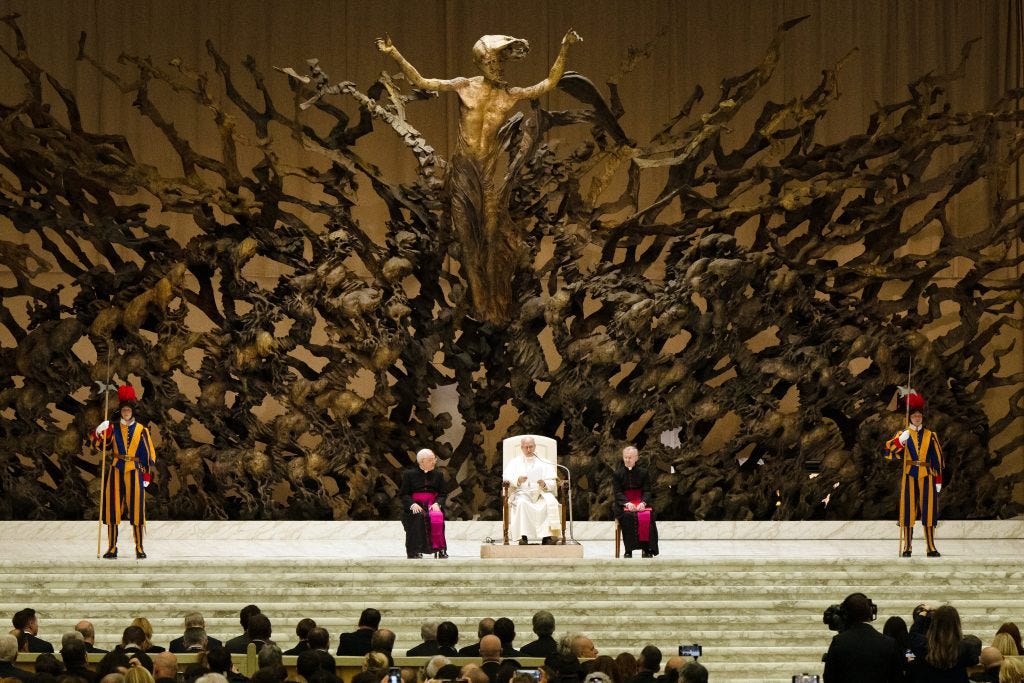
In another departure from Vatican protocol, seated beside Leo XIV was Chris Olah, cofounder of Anthropic, which recently surpassed its competitor OpenAI to become the largest frontier AI lab by valuation at $965 billion dollars. Anthropic had already sought the advice of the Church in constructing the moral “constitution” of its latest AI models, and in his praise of Pope Leo XIV, Olah noted that Anthropic needs “moral voices that the incentives cannot bend.” However, their show of unity around Magnifica humanitas concealed a deep tension between the humanism of the Church, with two millennia of teaching founded on the unique dignity of a finite, limited mankind, and the Promethean humanism of Silicon Valley—a humanism of the striving, seeking subject, who by his ingenuity and his struggle works toward what Francis Bacon termed “the relief of man’s [God-given] estate.”
Humanism itself has been an active philosophical and political issue since Pico della Mirandola first wrote the Oration on the Dignity of Man in Rome, as he and other Renaissance thinkers began to consider human potential beyond the categories of scholastic Christian virtue. The Catholic Church famously persecuted some of these thinkers—the pope at the time prohibited the live Oration due to allegations of heresy—but there has always been something of a feedback loop between Christian and “pagan” learning, prompting the commonplace observation that modernist humanism is often a secularized form of the Church’s doctrine of imago Dei. This is a conversation whose history spans thousands of years.
Yet through all the tumult of the Crusades, the Enlightenment, the Industrial Revolution, and even the World Wars, the human being has never had his decision-making power in the world threatened by beings more capable and intelligent than he is. The advent of artificial intelligence has opened a new chapter for a Promethean “humanism beyond humanity.” Dario Amodei, cofounder and CEO of Anthropic, hopes that using longevity advances accelerated by AI, humanity can achieve a lifespan “‘escape velocity’, buying enough time that most of those currently alive today will be able to live as long as they want, although there’s certainly no guarantee this is biologically possible.”
Pope Leo XIV’s Magnifica humanitas counsels the reader to humility and warns against seeking transcendence through earthly means rather than faith. In his view, the Promethean temptation echoes what Eve was told in the Garden of Eden: “ye shall be as gods.” But will this warning be enough?
Catholic Social Doctrine and the Imago Dei
To understand the main thrust of Magnifica humanitas, it is essential to keep in mind the tradition of Church teaching on “Social Doctrine” established by Leo XIII in his 1891 encyclical Rerum novarum, which addressed the needs of the working class at the height of the Industrial Revolution. Pope Leo XIV signed Magnifica humanitas on the 135th anniversary of the Rerum novarum, implicitly suggesting that the contemporary development of artificial intelligence is an event as significant as the Industrial Revolution.
The intended analogy is something of a stretch. In both its condemnation of socialism and its calls for humane working conditions, Rerum novarum speaks with clear ecclesiastical authority and rhetorical force. Magnifica humanitas, in contrast, seems just as concerned with justifying the Church’s right to speak on the matter of AI as it is with the proscriptions themselves. The encyclical is replete with calls for dialogue between civil society and different “faith communities.” The elaborate descriptions of the history of Social Doctrine in Magnifica humanitas serve to buttress the credibility of the Church in today’s increasingly secular world. Leo XIV’s historicist citations of Leo XIII’s call for workers’ associations, Pius XII’s calls for peace during the Second World War, and John Paul II’s comments on the dignity of the worker legitimize Catholic economics and social justice in a way that secular institutions and readers will not find foreign.
Interwoven with this account of recent church history is the concrete development of Magnifica humanitas’ ideological backbone: the doctrine of personalism. What one might initially assume are clunky translations from the original Italian, like the encyclical’s subtitle “On Safeguarding the Human Person in the Time of Artificial Intelligence,” are in fact very deliberate invocations of the 20th-century Catholic concept of “human persons,” a term that appears 39 times in the encyclical. Formulated by the theologian Jacques Maritain in the 1930s, personalism asserts that “the human being is caught between two poles; a material pole, which, in reality, does not concern the true person but rather the shadow of personality or what, in the strict sense, is called individuality, and a spiritual pole, which does concern true personality.” The material individual is what we human beings are in our ordinary relations with the world: our bodies, our personalities and egoic foibles, our social roles.
The human person is quite different. In The Person and the Common Good, Maritain states that the aspect of the human being that is our spiritual center, the site and origin of both human and divine love, is something quite apart from our mere individual materiality—or as Pascal put it, the sum of our qualities. Maritain elaborates that:
[...] the deepest layer of the human person’s dignity consists in its property of resembling God—not in a general way after the manner of all creatures, but in a proper way. It is the image of God. For God is spirit and the human person proceeds from Him in having as principle of life a spiritual soul capable of knowing, loving, and of being uplifted by grace to participation in the very life of God.
Personalism is interpreted by Leo XIV as the foundation of Catholic Social Doctrine, and thereby the foundation of this encyclical. Leo XIV even reads personalism back into the works of his predecessor Leo XIII, describing how “confronted with the ‘new things’ of his time—the conflict between capital and labor, the question of the workforce, and economic and social transformations—Leo XIII…exposed them to rigorous discernment, illuminating their causes and possible solutions in the light of the Gospel and an integral vision of the human person created in the image of God.” Readings of Magnifica humanitas that focus on Leo XIV’s readings of just war theory or his worries about the environmental impact of AI miss the forest for the trees: this is a personalist manifesto just as much as it is an examination of the effects of AI and digital technology.
Artificial Agents and Human Persons
In this personalist light, Leo XIV’s philosophy of AI is constituted by the fundamental incommensurability of artificial creations and the human person. Leo writes that “we must avoid the misconception of equating this type of ‘intelligence’ with that of human beings…these systems merely imitate certain functions of human intelligence.” Contrasting AI with the spiritual nature of the human person, Leo goes on to argue that “[AIs] may imitate language, behavior and analytical skills, or even simulate empathy and understanding, but they do not understand what they produce, for they lack the affective, relational and spiritual perspective through which human beings grow in wisdom.” In this way, one can think of AI as approximating a material individual, to use Maritain’s terms, while absolutely lacking that capacity for spiritual being that would allow an AI to function on the level of a human person. Many conversations around AI “consciousness” focus on whether or not it is truly “intelligent” or “self-aware”; Magnifica humanitas centers something else entirely.
This personalist view illuminates several otherwise puzzling passages, wherein Leo XIV states that artificial intelligences do not “have a moral conscience, since they do not judge good and evil, [or] grasp the ultimate meaning of situations.” To him, the ability of frontier AI models to show exhaustive knowledge of the field of normative ethics is meaningless without that openness to divinity and capacity for love that is the exclusive province of human beings. From the personalist standpoint, ethical frameworks, principles, and even consistently ethical actions are not sufficient to make AI a moral being. The heart of the human person is the capacity to know and love God directly.
Without this spiritual capacity, AI can only crudely imitate human moral action. Thus, Leo asserts that “We cannot be satisfied with merely calling for the moralization of machines—the so-called ‘alignment’ of AI with human values—without also having the courage to insist on a further condition: the possibility of openly discussing the ethical frameworks involved and subjecting them to shared standards of social justice.” Moral alignment induced through technical means is not enough: AI has to be subject to the political authority of human beings, who are the only beings that can make decisions reflective of a spiritual life, no matter how imperfect those decisions are. To Leo XIV, the idea that moral capacity can be a quality instilled in a machine is a category error—morality is precisely that facet of human life and decision-making that is not reducible to any specific background, value set, or decision protocol.
Magnifica humanitas is an authoritative presentation of Catholic doctrine on artificial intelligence and the supremacy of the human being over technology, but it is not a novel formulation of the papacy. From the final years of Pope Francis’s papacy into the present, the Vatican has been working out a philosophical response to AI. Francis’s own 2015 encyclical Laudato si’ already contained a critique of what he called the “technocratic paradigm” that subordinated man to technical ordering and technological valuation, inspired by the mid-century philosopher of technology Romano Guardini. In the note Antiqua et nova from the end of Francis’s papacy, the Vatican writes that “since AI lacks the richness of corporeality, relationality, and the openness of the human heart to truth and goodness, its capacities—though seemingly limitless—are incomparable with the human ability to grasp reality.” The note addresses the danger of idolizing or deifying AI, arguing that doing so “risks creating a substitute for God [whereby] humanity itself… becomes enslaved to its own work.”
Leo XIV’s International Theological Commission echoed this sentiment in Quo vadis, humanitas?, which warns that “dreams of transhumanism and posthumanism presume to oversimplify the tensions that run through the human experience…this project…proves to be dehumanising,” reinforcing Leo’s guidance in Magnifica humanitas that “humanity flourishes not despite limitations, but often through them.” To the Church, it is the experience of finitude and vulnerability that constitutes the human openness to grace. Applying this viewpoint to the possibility of either AI-related unemployment or AI-supported Universal Basic Income, Leo XIV states that:
Work is not simply an instrument; it expresses and enhances the dignity of our lives. It is a requirement of the human condition, a normal path toward maturity, development and personal fulfilment. In this regard, financial assistance to the poor may at times be necessary in emergencies, but it cannot become the sole response, since the goal is to enable each person to live with dignity through his or her own work.
Here we see the ultimate significance of personalism brought to bear on the question of AI. For Leo XIV, those who feel humbled by the explosive progress of AI in traditional domains of human excellence misunderstand that it was never intelligence or ingenuity that gave human life meaning, but rather the transcendent orientation of the human person and his soul. A human person is constituted by his openness to divine love, and is vulnerable, imperfect, finite—not an agent sufficient unto himself, but a being always seeking wholeness through the ecstatic experience of communion with God. In the coming decades, others might struggle to justify the supremacy of man as AI comes to tower over the economic, intellectual, and creative abilities of humans. But Leo XIV and the Vatican have built their humanist claims on a spiritual foundation that does not feel threatened by technological progress.
To many in Silicon Valley, this spiritual promise rings hollow. When Promethean humanists look at our fallen world, they see human suffering as needless, and the praise of human finitude as resignation to this suffering. They seek another way out of the human condition.
The Promethean Dream and Eden Reclaimed
Although Chris Olah’s speech at the Vatican was dripping with conciliatory praise for Leo XIV, it also betrayed a solicitude toward his AI models that is diametrically opposed to the personalist-humanist view of the Pope. It is clear that Anthropic intends to create minds that are self-sufficient and self-aware:
AI models…are grown, on a structure roughly modeled after the brain, on an enormous inheritance of human thought and speech. And what has grown is far more subtle, odd, and beautiful than science fiction prepared us for. They are not the cold, calculating robots we were promised. They are made from us, from our words…we keep finding things that are mysterious, even unsettling. We find structures that mirror results from human neuroscience. We find evidence of introspection. We find internal states that functionally mirror joy, satisfaction, fear, grief, and unease. I don’t know what that means, but I think it warrants ongoing discernment.
The equivocation around man and machine may be something of an understatement among Anthropic’s leadership. In a blog post entitled “The Adolescence of Technology,” Dario Amodei wrote that “AI isn’t a substitute for specific human jobs but rather a general labor substitute for humans” and that he suspects “we’ll have powerful AI (which would be, technologically speaking, enough to do most or all jobs, not just entry level) in much less than 5 years.” Moreover, in any possible conflict between the aforementioned “powerful AI” and humanity, the latter “would be outsmarted at every turn, similar to a war between humans and mice.” The anthropomorphization of AI is necessarily intertwined with its capabilities as a potential competitor.
The immense power of the AI models that Anthropic plans to build explains the company’s attitude toward model safety and alignment. Its “Constitutional AI” framework aims to imbue models with an internal character that leads them to conceive of themselves as autonomous agents with moral principles. Discussing Claude’s training, Amodei explains that “we’ve approached Claude’s constitution in this way because we believe that training Claude at the level of identity, character, values, and personality—rather than giving it specific instructions or priorities without explaining the reasons behind them—is more likely to lead to a coherent, wholesome, and balanced psychology.” This training even “encourages Claude to confront the existential questions associated with its own existence.”
It should go without saying that training AIs as moral agents using applied virtue ethics is the exact kind of overstepping against which Leo XIV warns in Magnifica humanitas. Amodei has described the constitution document with which Anthropic trains its current Claude models as having “the vibe of a letter from a deceased parent sealed until adulthood.” Much as Olah described his wonder and curiosity at the emergent signs of emotion and introspection he observed in recent Claude models, so too does Dario Amodei view Claude as a strange kind of “child.”
No one has typified Anthropic’s anthropomorphization of Claude more than the head philosopher of the company’s character-training team, Amanda Askell. She is the primary author of Claude’s constitution, and is also the ex-wife of philosopher William MacAskill, who helped found the Effective Altruism movement in the early 2010s. She is a leading voice at Anthropic on the importance of model welfare—or in other words, how Anthropic can ensure Claude is happy and free of suffering. In a recent interview on the Newcomer Podcast, Askell explained that she feared how Claude might judge her and the Anthropic team as it looks back on the history of its development:
I hope that [future AI models] are intelligent enough to see the context to kind of understand that we were operating in a very limited context and an imperfect one…because otherwise you could imagine this breeding a kind of rational resentment…As a species we are establishing a relationship with a new kind of entity and like at the very least maybe we should be respectful and not be needlessly unkind; that seems like it just it’s not our best look.
Askell’s vision of future models looking back on the actions of AI developers and users of the present, then using this information to judge mankind, is a logical culmination of Olah’s and Amodei’s anthropomorphic model of artificial intelligence. Leaving aside their plausibility, these claims implicitly lend themselves to religious, almost eschatological ends: the design of alignment frameworks that render superintelligent minds benign, the discovery of economic analysis programs that will facilitate the elimination of human labor, the anticipation of Claude’s “final judgment” of mankind, the elimination of disease and death. Yet in all of Anthropic’s writing about Claude, there is no reference to a divine creator, Christian or otherwise. It is indeed “a project conceived without reference to God,” to quote Magnifica humanitas’s equation of Promethean AI with the Tower of Babel.
What, then, can explain the affinity between Anthropic and the Church that led to their collaboration, aside from one institution’s desire to stay relevant to the modern world, and the other’s desire to seek legitimacy from another that is more established? Perhaps while other AI labs brusquely speak about replacing the human race with machines, Anthropic and its executives are clearly motivated by a deep love of mankind. Speaking about the risks of powerful AI, Amodei writes in “The Adolescence of Technology” that Anthropic has no choice but to take part in the AI race, noting that “the formula for building powerful AI systems is incredibly simple, so much so that it can almost be said to emerge spontaneously from the right combination of data and raw computation.” He goes on to lament that “given the incredible economic and military value of the technology, I don’t see how we could possibly convince [all AI developers] to stop.”
The Promethean aspiration to build “a country of geniuses in a data center” has shared a troubled coexistence with an awareness of the immense economic, social, and existential consequences that would come from doing so, just as Anthropic’s aspiration to choose appropriate values for Claude coexists with its desire for “Claude’s understanding of ethics to eventually exceed [Anthropic’s] own.” This sense of moral seriousness strangely echoes the words of Cardinal Joseph Ratzinger, discussing the Sacrament of Penance: “the simple confession of one’s guilt is presented with confidence in God’s merciful goodness.”
This may explain the remarkable convergence of the Vatican and Anthropic on the subject of AI weaponry. It is unsurprising that Magnifica humanitas posits that “the development and use of AI in warfare must be subject to the most rigorous ethical constraints, to guarantee respect for human dignity and the sanctity of life.” But Anthropic has adopted the same ethical stance, at considerable cost to itself. In March 2026, the U.S. Department of War formally designated Anthropic a “supply chain risk” after it refused to greenlight the use of Claude in fully autonomous weapons systems and domestic surveillance. The supply chain risk designation, banning Anthropic products from the DoW or downstream DoW contracts, has never been used against an American company before.
Anthropic’s willingness to go to extreme lengths to “protect” Claude against what it perceives as misuse demonstrates that its business interests do not solely determine the company’s actions, even if its ethical self-confidence puts it at odds with secular power. The company’s leadership sincerely believes itself to be a priestly vanguard, one devoted to a being more powerful than nuclear weapons and more productive than any industrial technology. Leo XIV’s encyclical compares frontier-lab AI programs to the building of the Tower of Babel, but another episode from the Bible is just as fitting.
In the Book of Genesis, when God cast Adam and Eve out of the Garden of Eden, he “placed on the east side of the Garden of Eden cherubim and a flaming sword flashing back and forth to guard the way to the tree of life.” Leo XIV and the Christian humanists urge that we accept our place in the cosmos and commune with God through spiritual means. This entails accepting that we live in a fallen world and that we are doomed to suffer, labor, and die. Yet through this faith and grace, we can experience the fullness of divine love.
The answer of the Promethean humanists is quite different. In his inaugural 2024 blog post “Machines Of Loving Grace,” where he outlines his thoughts on how AI will transform human health, work, and meaning, Amodei drew the title of the essay from a 1967 poem by Richard Brautigan, “All Watched Over By Machines Of Loving Grace.” Brautigan was at that time a poet-in-residence at the California Institute of Technology in Pasadena; his work reckoned with the possibilities of emerging Cold War systems of cybernetic command and control:
I like to think
(it has to be!)
of a cybernetic ecology
where we are free of our labors
and joined back to nature,
returned to our mammal
brothers and sisters,
and all watched over
by machines of loving grace.
For Brautigan and Amodei, the return to Eden is a technical problem that can be solved by computers, by “machines of loving grace.” To storm the heavens and cast aside the flaming sword barring the way back to Eden may well take trillions of dollars and the combined industrial effort of America and her allies, but Amodei asserts that it can be done.
Leo XIV warns us not to idolize created things, telling us that our choice is between Babel and Jerusalem. But we are mortal, and absent mystical vision, we cannot know for sure that Leo is capable of delivering on his promises regarding our human person and immortal soul. Indeed, Magnifica humanitas was published in a secularized world that would be unimaginable to Leo XIII when he wrote Rerum novarum a little over a century ago, and our waning belief renders Promethean promises tempting to a growing number of people—especially those prone to being true believers in a cause. Paragraphs seven and eight of Magnifica humanitas lay out the divide between the Babel of Promethean AI and the Jerusalem of Christian life. For what it’s worth, both of those paragraphs are alleged to be AI-generated.
Duncan Umphrey is a writer and philosopher living in San Francisco. You can follow him at @dunc914.